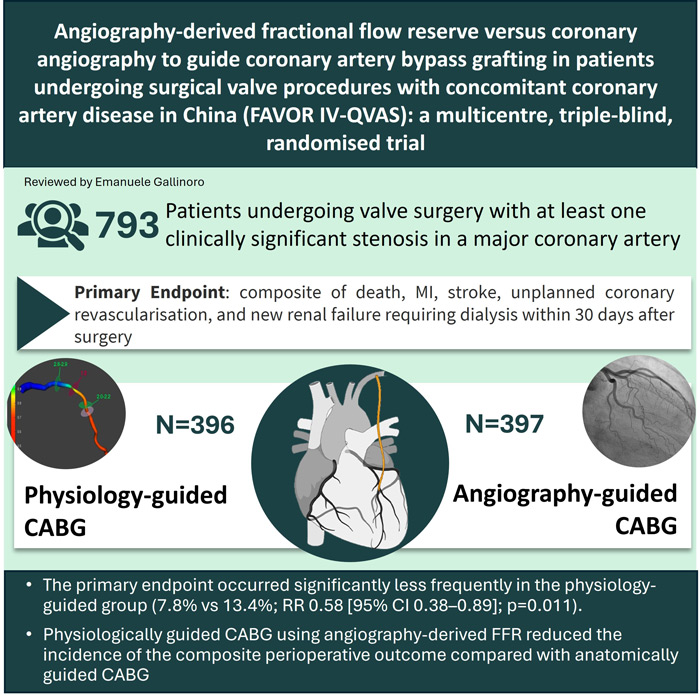
Designed by Emanuele Gallinoro - Source iHeartFunction.com - Graphical summary of coronary artery bypass grafting (CABG) strategies in FAVOR IV-QVAS, illustrating selective revascularisation of functionally significant coronary lesions based on angiography-derived fractional flow reserve versus conventional anatomy-guided grafting of all angiographically significant stenoses.
Why this study – the rationale/objective?
Fractional flow reserve (FFR) provides a functional and quantitative assessment of coronary stenoses and has been shown to improve outcomes when guiding percutaneous coronary intervention (PCI) compared with angiography alone. More recently, angiography-derived FFR has emerged as a less invasive alternative, allowing physiological assessment without the need for pressure wires or hyperaemia. Whether this physiology-guided paradigm can be translated to coronary artery bypass grafting (CABG) remains unclear, with prior trials yielding conflicting results.
How was it executed – the methodology?
FAVOR IV-QVAS was an investigator-initiated, multicentre, randomised, triple-blind trial including 793 patients undergoing valve surgery with at least one clinically significant coronary stenosis (≥50% in a major vessel ≥1.5 mm) across 12 centres in China. Angiography-derived FFR was analysed in an independent core laboratory. For each patient, an independent surgical panel predefined two revascularisation strategies—one physiology-guided and one anatomy-guided—ensuring blinding of the operating surgeon to the underlying allocation.
Patients were randomised 1:1 to:
- Physiology-guided CABG (FFR ≤0.80; n=396), or
- Angiography-guided CABG (stenosis ≥50%; n=397)
The primary endpoint was a 30-day composite of death, myocardial infarction, stroke, unplanned revascularisation, or new reanl failure requiding dialysis.
The key secondary outcome was a composite of all-cause death, myocardial infarction, stroke, unplanned coronary revascularisation, hospitalisation for unstable angina, and hospitalisation for heart failure at 1 year and 3 years of follow-up
What is the main result?
The population had a median age of 65 years (IQR 59–70), with 28% women. Valve disease was predominantly degenerative (74%), followed by rheumatic (22%), and most commonly involved mitral regurgitation (54%). Coronary disease complexity was low (median SYNTAX score 8), with preserved left ventricular function (median LVEF 61%) and low operative risk (median STS-PROM 2.8%).
Notably, concomitant CABG was performed in only 56% of patients in the physiology-guided group compared with 98% in the angiography-guided group. This translated into fewer grafts, shorter cardiopulmonary bypass and cross-clamp times, and reduced transfusion requirements. The primary endpoint (a 30-day composite of death, myocardial infarction, stroke, unplanned revascularisation, or new dialysis) occurred significantly less frequently in the physiology-guided group (7.8% vs 13.4%; RR 0.58 [95% CI 0.38–0.89]; p=0.011). This corresponds to an absolute risk reduction of 5.6%, with a number needed to treat of approximately 18 to prevent one event. The benefit was mainly driven by a substantial reduction in perioperative myocardial infarction (1.5% vs 5.6%) and lower rates of new renal failure requiring dialysis (2.3% vs 4.6%). Differences in mortality (2.8% vs 4.3%) and stroke (1.5% vs 2.3%) numerically favoured the physiology-guided group but were not statistically significant. At a median follow-up of 27 months, the benefit of physiology-guided CABG was sustained. The composite endpoint of death, myocardial infarction, stroke, unplanned revascularisation, or hospitalisation for unstable angina or heart failure occurred in 20.7% of the physiology-guided group and 26.8% of the angiography-guided group [HR 0.74 (95% CI 0.55–0.98; p=0.036)] with no significant interaction between randomised treatment and log(time) in the extended Cox model (p=0.18)
Critical reading and the relevance for clinical practice
Whether the benefits of FFR-guided revascularisation observed in PCI extend to surgical settings has remained uncertain, with previous studies yielding conflicting results. The FARGO trial randomised 100 patients to angiography-guided versus FFR-guided CABG and found no difference in graft failure (16% vs 12%) or clinical outcomes at six months, although the predominance of saphenous vein grafts (>75%) may have influenced these findings.
Similarly, in the GRAFFITI trial (n=172), FFR-guided CABG did not improve graft patency or clinical outcomes at one year compared with an angiography-guided strategy. Notably, both FARGO and GRAFFITI included a substantial proportion of vein grafts, which are less susceptible to competitive flow and therefore less likely to demonstrate a physiological advantage of FFR guidance.
In contrast, the IMPAG study (n=67) provided important mechanistic insight. In patients undergoing total arterial CABG, preoperative FFR—but not angiographic stenosis severity—was strongly associated with graft functionality at six months. Anastomoses to vessels with FFR ≤0.78 showed excellent patency (~97%), supporting the concept that physiology is a key determinant of arterial graft performance.
However, applying FFR to guide surgical revascularisation raises important theoretical concerns. Beyond restoring flow, CABG may provide a form of “surgical collateralisation,” offering protection against future coronary events irrespective of lesion severity. A physiology-guided approach could therefore attenuate this protective effect. In addition, anatomically incomplete revascularisation—an inherent consequence of FFR-based deferral—has been associated with worse outcomes after CABG.
Against this background, the present study provides important new insight. Physiologically guided CABG resulted in fewer grafts and a lower incidence of the composite clinical endpoint. These findings are likely mechanistically linked: fewer grafts translate into shorter operative times and reduced cardiopulmonary bypass exposure, thereby limiting myocardial and renal injury.
Importantly, FAVOR IV-QVAS addresses many of the limitations of previous studies. It is the first adequately powered, multicentre, triple-blind trial in this field, with rigorous allocation concealment through pre-specified surgical plans—ensuring true masking of the operating surgeon. High protocol adherence and complete follow-up strengthen the internal validity, while the use of angiography-derived FFR analysed in a core laboratory enhances reproducibility. The consistency of results across subgroups further supports the robustness of the observed treatment effect.
Interestingly, the observation that the treatment effect was most pronounced in the early postoperative period further supports the concept that the benefit is primarily driven by reduced perioperative injury rather than late divergence. The key question, however, is whether this early advantage will translate into durable long-term benefit. It remains uncertain whether deferring revascularisation of angiographically significant but physiologically non-significant lesions may lead to higher rates of late target-vessel events, potentially offsetting the initial gains. Longer-term follow-up will therefore be essential to determine whether angiography-derived FFR-guided surgery represents a true paradigm shift or an early perioperative advantage.